
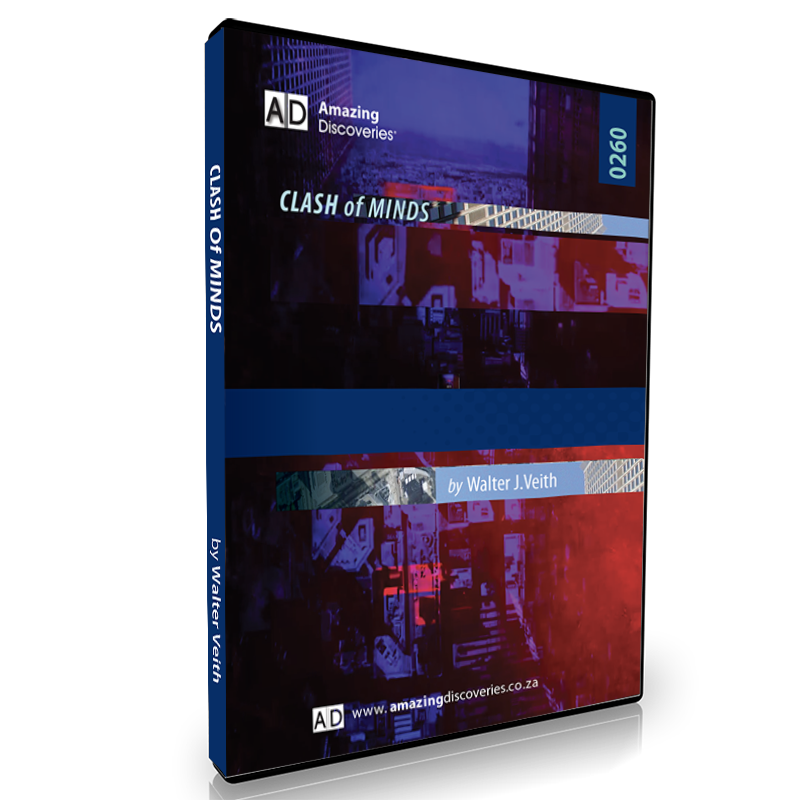

We are all living together on Earth and need to figure out how to get along. With a population of over 7 billion people, this may not always be easy. We all have different backgrounds, ethnicities, beliefs, and desires. Though different, we are also unique and special in God’s eyes. He sees us as individuals with the freedom to choose Him daily. We are different, but many see these differences as divisive. Different denominations believe in different things, and these different belief systems prioritize theology differently.
It’s difficult enough to encounter division between Christians and unbelievers, but how much more troubling is it when Christians disagree amongst themselves? In this 9-part series with professor Walter Veith, discover some of the differences between believers and consider whether we can find a solution in Scripture. Whenever we are in doubt and if we encounter a Clash of Minds, go to God. He has the answers to all of our troubles.
Lecture 1: Verily My Sabbaths – 70 Minutes
We cannot pick and choose the commandments that we want to keep just because they are easy. We must give God all or nothing. Choose to obey the Sabbath and give the Lord your all, today.
There are only 10 Commandments. Out of the thousands of man made laws, the 10 Commandments do not seem harsh or difficult to keep in comparison. One of these laws, however, seems to be a contentious issue in our current day. Many have stopped keeping the Lord’s day holy. The Sabbath is a sign of God, and keeping the Sabbath shows righteousness by faith. Keeping the Sabbath is not an option, and it is not a small issue. The Sabbath is a life or death issue. If we are to avoid certain death, we must first understand the meaning of the Sabbath. Exodus 31:13 says, “Speak thou also unto the children of Israel, saying, Verily my Sabbaths ye shall keep: for it is a sign between me and you throughout your generations; that ye may know that I am the Lord that doth sanctify you.” If we choose against this ordinance, we are choosing against life.
The Bible mentions the Sabbath almost 150 times. What makes the Sabbath so important, and why is it especially important for God’s people? There is an enemy that wants to instill backwards and unBiblical beliefs in us. This is a massive battle, in fact it is a clash of minds. In this first part of Clash of Minds: Verily My Sabbaths, Walter Veith describes how keeping the Lord’s day means having a real relationship with God. Hear about the benefits of a deep and meaningful bond with our Heavenly Father, which we can only accomplish by following His divine law.
Lecture 2: Righteousness by Faith in Verity Part 1 – 75 Minutes
What does righteousness by faith involve, and can we separate the law from faith?
If God gave His one and only son for us to die, and Jesus sacrificed everything for us, can we find it in ourselves to make certain sacrifices for Him too? Jesus is knocking at the door of our lives, and it’s up to us to open that door to invite Him in. Only through letting Him in can we create, nurture, and grow in a relationship with Christ. This relationship entails fantastic peace and joy, but it also involves disappointment and pain sometimes. Learn what the message of righteousness is, and what aspects of our lives are part of the recipe of righteousness.
Can we find righteousness by following God’s law and His law only? Or does faith have to be part and parcel of the deal? In this lecture with Walter Veith, we examine the Bible and learn about justification. Discover how we cannot separate the law from faith, and how law is integral to righteousness. The Reformers knew about this important relationship from the start, and Seventh-day Adventists preach this message worldwide, but why is it still so unclear? Let us determine the relationship between law and grace and understand what it really means to have righteousness by faith in verity.
Lecture 3: Righteousness by Faith in Verity Part 2 – 77 Minutes
God sent His one and only beloved Son to die for us, and still many believers are reducing Jesus to being less than the church.
We may be very strong in Protestant beliefs, but what do we know about Rome’s position on justification? How does Rome view the atonement? In Righteousness by Faith in Verity Part 2, we investigate the Catholic view on the Bible and also the Catholic view of Protestants.
In this lecture featuring Walter Veith, we closely examine Catholic sources that show the lessening of Jesus and the uplifting of the Catholic church. See how Catholics desire a closer relationship with the church, whereas we should be seeking a closer and personal relationship with Christ. Through exploration of key Catholic excerpts, we discover the troubling idea that some may believe in unBiblical theories rather than truth. Learn more about the salvation by faith or salvation through works issue and witness how the world is becoming an increasingly challenging and turbulent place. Decide for yourself whether you should go to the Pope and to the church for answers, or to the Everlasting God.
Lecture 4: Righteousness by Faith in Verity Part 3 – 51 Minutes
The world is moving toward religious unity. Though there are certainly similarities between religions, that does not mean we should seek unity. Divisions exist for many reasons, and we must examine why we are so different.
Lately in the religious world we have heard a lot of talk about unity. Amidst all the earthly conflict, we hear pleas for ecumenism time and time again. Pope Francis has been working toward an improved relationship between Protestants and Catholics. Upon initial observance, this may sound ideal and wonderful, but is unity really Biblical? Is unity the solution the world needs?
In this lecture with professor Walter Veith, discover how the world is slowly and dangerously moving toward ecumenism. The world is surely replacing and lessening Jesus with something else, something earthly. Instead of having a personal one-on-one relationship with Christ, we are to approach our churches, our bishops, and our pope for a spiritual experience. Is this the faith we are called to have?
Lecture 5: A Double Portion – 95 Minutes
Can we receive more spirituality than we already have? Watch as Professor Veith explores 2 Kings and the story of Elijah and Elisha, and how we should all be praying for double portions in our own lives. Do we have enough knowledge and strength to arm ourselves against the war upon God’s word?
What does it mean to receive a double portion? Hear Professor Walter Veith explore the Elijah story in 2 Kings 2:9, “And it came to pass, when they were gone over, that Elijah said unto Elisha, Ask what I shall do for thee, before I be taken away from thee. And Elisha said, I pray thee, let a double portion of thy spirit be upon me.” How can we analyze what the double portion refers to? As God’s people, how can our portions be affected by our life choices? Veith discusses how this message concerns God’s end time people more than we may think.
Pay heed to Veith’s message as he warns us that our path as believers is not easy, but as a distinctive people – set apart – God has chosen us to spread the message of Elijah. Veith explains how Elijah’s message is a critical one that we should all hear, and encourages us to pray for a double portion in all of our lives.
Lecture 6: Without Me You Can Do Nothing – 80 Minutes
What is the ultimate defence against living amongst the spiritually dead? Listen to this powerful video with Walter Veith about how we are experiencing a battle of the mind, and how Jesus Christ is the one and only way out of the darkness.
If we rejected Jesus the first time He walked on this earth, do you think we’re prepared to accept Him at His second coming? Might we reject Him all the more after 2,000 years of sin? So why is it that human beings choose to continually spurn and shun Him? Listen as Walter Veith proposes that we have an ongoing battle in our minds. If our salvation starts in the mind, how can we defend our minds against the devil’s attack? A possible solution is to “Metanoia,” meaning to think differently, to reconsider, to adopt a new paradigm, and to change our perspective.
Veith shows us how we have been struggling to maintain goodness within us over the centuries, and how Jesus Christ is the only way to free ourselves from the battle of mind against mind. Veith smartly proposes that we can defend ourselves with Christian morals, that’ll defend us against the evil powers that might try and sneak into our minds. Veith implores us to run to the living Jesus, instead of temporary earthly substitutes for happiness. But we are unable to escape death without Jesus. We cannot do it ourselves, as we so often try to do. We can only achieve freedom and salvation through Jesus. Truly, without Him, we can do nothing.
Lecture 7: The Herodian Mind Part 1 – 100 Minutes
How often do we ignore God’s laws in favour of earthly rules and beliefs? We always find justification for our fleshly impulses, but do our actions reflect that Christ is in our hearts? Walter Veith explores the Herodian Mind and methods in which we can reconcile our worldly laws with God’s law.
We know our society has rules. If these rules coincide with the rules of the Bible, then we do not come into conflict. However, when our culture disagrees with the Word of God, we often have a Herodian Mind about important issues. What does this imply? Consider that we are not to put our trust in Herod – who held great political power in Biblical times – but we ought to put our faith and hope in Jesus. There are modern equivalents of Herod today, but can we recognize them? Walter Veith reveals different deities and how these religious structures have evolved to rule over our modern culture, shadowing the true God.
Veith warns us to recognize the symbols of the false religions, in order to discern truth from error. Veith, with further evidence from scholars and literary analysts, extrapolates the marks and actions of different religious figures and gods. Walter Veith delves deeper into history, speaking about different false religions that all follow this Herodian mind. Discover what it means to reconcile our worldly laws with God’s law.
Lecture 8: The Herodian Mind Part 2 – 65 Minutes
Since we cannot see God, we often feel compelled to grow closer to earthly authority figures. Sometimes we trust in political or social leaders, hanging on their every word, deceived by their friendly and welcoming masks. Professor Walter Veith finishes off his lecture on the Herodian Mind, reminding us to choose the one true God over the earthly gods that evil has produced and propagated throughout our culture.
Watch part 2 of the Herodian Mind, as professor Walter Veith further discusses the enmity between us and God. Is someone to blame? Veith proposes that there isn’t just one evil, but that the devil has put the mark of Cain upon multiple authorities. Sometimes the evil one disguises himself in multiple discreet ways. Veith goes into great detail about secret societies, groups, and even individuals that have become politically powerful in dark ways. Witness evidence that top leaders in our society have alternative motives, and how different parts of the world are all falling victim to these powers.
In many historical examples, powerful authority figures hide behind a welcoming and friendly mask. However, is there something more sinister behind the mask? When we cannot discern the evil behind the mask with the truth, we must be reminded that Jesus is our only defence against deception, and that we are to follow God’s word and not the word of the world.
Lecture 9: I Think Therefore He Is – 105 Minutes
The famous philosophical phrase “I think, therefore I am” implies that our own logic and reasoning has led to our existence, and that we are powerful enough to create our own truth. This theology shifts the focus and power from God to men. Professor Walter Veith shows how we are not the Almighty, and just because we think, does not mean that we are. Watch this video to understand the truth: I think, therefore He is.
Rene Descartes, a famous Jesuit philosopher came up with the famous phrase “I think, therefore I am.” This implies that we define our own morality, we invent our own truth, and we created ourselves. This theology shifts the power from God, to men. However, this popular belief contradicts Gospel truth. Professor Walter Veith shows us shocking proof that men are now lessening God’s divine power, and raising ourselves up to His level.
This video is a study into the differing Christian philosophies regarding how some believe our reason is informed by faith, instead of our faith being informed by reason. Veith shows us how our faith is formed, grown, and nurtured through our reason, and how through careful study we can see how He cannot be overthrown by man. Men in this age believe that we are made stronger and better through our reason and thinking, making us all powerful. Just because we think, does not mean that we are. True power and strength does not come from us. Watch this final video to see the truth: I think, therefore He is.
| Weight | 0,192 kg |
|---|---|
| Dimensions | 19 × 13,5 × 2 cm |
| Author | Walter Veith |
| Category | DVD |
| Type | DVD Disk |
| Topic | Bible Doctrine |
| Language | English |


Reviews
There are no reviews yet.